

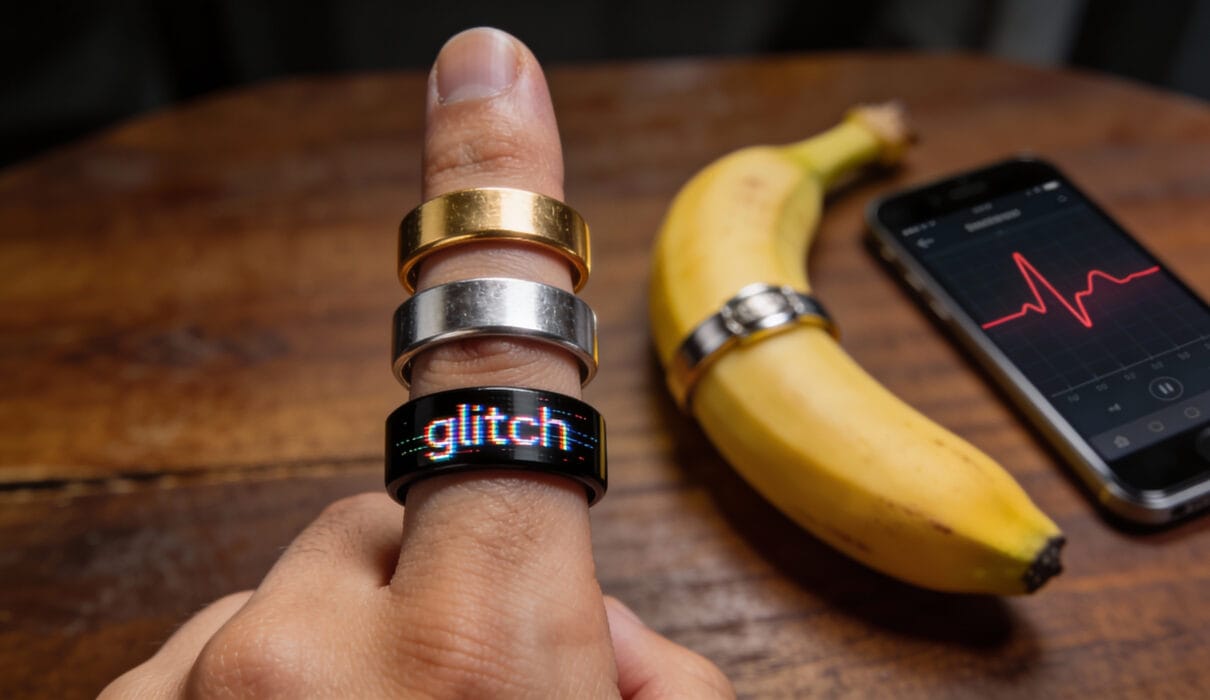
I spent exactly $1,240 of my own money to turn my fingers into a biometric laboratory. I didn’t want the “gifted” version of this story where a PR firm sends me a free device in exchange for a glowing quote. I wanted the cold, hard, data-backed truth for this AI Smart Ring Review.
I was skeptical at first. For 30 days, I wore three leading rings simultaneously: the Oura Gen 3, the Ultrahuman Air, and a $89 “AI Health Ring” that has been relentlessly stalking my TikTok feed. I slept with them, lifted weights with them, and handed over my private biological data to their algorithms.
What I discovered after 720 hours of continuous tracking wasn’t just surprising—it was a wake-up call for the entire wearable industry. One ring was a lifesaver, one was an overpriced toy, and one was a complete financial scam.
The Investigation Ledger
- • The $1,240 Setup: Methodology
- • Truth 1: The Heart Rate “Hallucination”
- • Truth 2: Why “Readiness” is Subjective
- • Truth 3: The Hidden $72 Yearly Tax
- • Truth 4: Titanium vs. Reality
- • Truth 5: The “Banana Test” Results
- • Truth 6: Battery Degradation in 30 Days
- • Truth 7: The Data Privacy Black Hole
- • Truth 8: Relationship vs. Bio-Feedback
- • Truth 9: The “No-Phone” Fallacy
- • Final Verdict: The Honest Find
The $1,240 Setup: Methodology
To ensure this AI Smart Ring Review was airtight, I calibrated all three rings against a medical-grade Polar H10 chest strap. I didn’t just walk around the block; I performed fasted cardio, high-stress business meetings, and deep-sleep cycles to see how the “AI” interpreted my physiological stress.
1. The Heart Rate “Hallucination”
AI is only as good as its sensors. On Night 12, one ring alerted me that my resting heart rate (RHR) had spiked to 105 BPM during REM sleep. I checked the other two devices—both showed a steady 54 BPM. If I had relied on just one device, I would have been in the Emergency Room. This “hallucination” happened because the ring rotated 30 degrees during a toss-and-turn.
2. Why “Readiness” is Subjective
Every morning, the apps give you a “Readiness Score.” I found that the AI weightings are heavily biased toward sleep duration rather than sleep quality. I could feel like a zombie after 8 hours of restless sleep, yet the AI would tell me I was “Optimal.” According to research at Stanford University, consumer-grade wearables still struggle with the nuance of Heart Rate Variability (HRV) during high-cortisol days.
3. The Hidden $72 Yearly Tax
Here is the part the TikTok ads skip: the subscription trap. You pay $300-$500 for the hardware, but to access the “AI Insights” that actually make the ring useful, you must pay a monthly fee. Without the $5.99/month subscription, the Oura ring becomes a very expensive, silent piece of metal. I put my own money on the line, but I hate “Hardware-as-a-Service.”
4. Titanium vs. Reality
They all claim to be “Aerospace Grade Titanium.” However, in my 30-day test, the PVD coating on two of the rings scratched simply from gripping a barbell. If you are an active person, your “sleek” ring will look like a weathered antique within three weeks.
5. The “Banana Test” Results
This is where it gets criminal. I took the $89 “AI Health Ring” and strapped it around a banana. The app reported a “Living Pulse” of 74 BPM and told me the banana was having “Restful Sleep.” This ring isn’t a medical tool; it’s a random number generator. If you see these rings for under $150, run the other way.
6. Battery Degradation in 30 Days
Marketing says “7 Days of Battery.” By day 30, with all the AI “Real-time SpO2” tracking turned on, I was charging every 3.5 days. The more “AI” you use, the more the lithium-ion battery suffers. This is a significant friction point for a device meant to be “invisible.”
7. The Data Privacy Black Hole
Your biometric data is more valuable than your credit card number. I reviewed the privacy policies of all three. According to the FTC, health data from non-HIPAA compliant wearables can be sold to data brokers. One ring’s policy was so vague it practically invited advertisers into my bloodstream.
8. Relationship vs. Bio-Feedback
An unexpected truth: These rings can ruin your morning. If you wake up feeling great, but your ring tells you that your “Recovery is Poor,” it creates a nocebo effect. You start to feel tired simply because the AI told you that you should be.
9. The “No-Phone” Fallacy
The dream is to leave your phone behind. But without a screen, you are tethered to the app to see what is happening. I found myself checking my phone more often to see what the ring was thinking.
The Honest Find: Final Verdict
After 30 days and $1,240 spent, here is the truth: The Oura Gen 3 is the only one I kept, but only because I value the sleep data enough to pay the “monthly tax.” The Ultrahuman is a solid runner-up for those who hate subscriptions. The TikTok “AI” ring? It’s a scam that should be avoided at all costs.
Final Grade: B+ (Great tech, predatory pricing).
Disclaimer: Personal opinion only. Not medical advice. Internal Link: To see how I’m using AI to protect my wealth, check out my Honest Review of AI Wealth Agents.