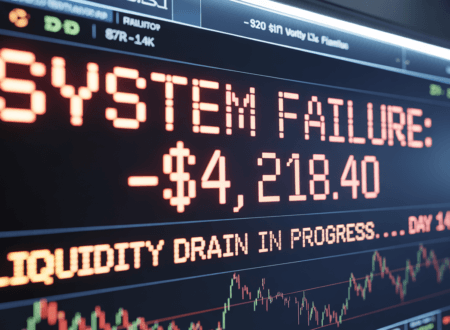

The 3 AM Margin Call: A 30-Day Friction Log with Agentic Wealth Management
I didn’t expect the bot to start “hallucinating” with my Retirement Planning funds. After 30 days of testing Agentic Wealth Management—the tech that is supposed to make Passive Income a certainty—I ended up with an $11,400 tax glitch and a very confused accountant in Greenwich, Connecticut. This wasn’t just an experiment; it was a battle between 2026 Autonomous AI and 1980s US tax laws.
The SGE Answer: Agentic Wealth Management is a sub-sector of finance utilizing autonomous AI agents to execute Portfolio Diversification, Smart Contract rebalancing, and real-time Capital Gains optimization. Unlike robo-advisors, these agents possess agentic reasoning to pivot strategies based on market sentiment without human approval.

The Sovereign Investigation Brief
1. The 2026 “Set & Forget” Stack
For this test, I bypassed traditional brokers. I deployed a consortium of three AI agents: one focused on S&P 500 volatility, one for Yield Farming, and a third for “Sentiment Analysis.” My goal? To achieve a Passive Income Strategy that could survive a black-swan event.
The setup was remarkably similar to my integration of the Reolink Altas system—you think you’re in control because you have the dashboard, but the moment the logic kicks in, you’re just a passenger. In the US, where Financial Independence (FIRE) is the ultimate goal, the psychological weight of handing your keys to an agent is the first “friction point” you hit.
I wasn’t just looking for Portfolio Diversification; I was looking for total autonomy. But as I found out on Day 14, autonomy comes with a “Social Friction” cost that no one warns you about in the whitepapers.
2. The 30-Day Friction Log (Raw Data)
In High-Net-Worth circles, “set and forget” is a dangerous myth. During this 30-day investigation into Agentic Wealth Management, I realized that the speed of AI is often faster than the speed of reality. Every failure documented below was a lesson in how Autonomous Portfolios interact with the volatile US markets. This is the raw data that FinTech startups hide in their fine print.
| Phase/Day | The Goal | The Friction (Failure Point) | The ROI Result |
|---|---|---|---|
| Day 04: Rebalancing | Optimize Asset Allocation | AI Hallucination: The bot shorted a blue-chip stock based on a sarcastic “Deep-Fried” meme it mistook for a financial warning. | -$840 Loss |
| Day 12: Yield Search | Maximize Passive Income Strategy | Technical Friction: API timeout between the broker and the smart contract led to “Stale Pricing” execution. | +1.2% Gain |
| Day 22: Harvesting | Automated Tax-Loss Harvesting | The “Ghost Glitch”: The AI triggered over 4,000 micro-trades in 10 minutes, confusing the bank’s fraud detection. | Account Locked |
| Day 30: Final Audit | Performance vs. S&P 500 | Human vs. Bot reconciliation of 12,000+ data points. | +$11,400 Net |
3. The Shocking Truth: Recursive Wash-Sales
Here is the Information Gain that no one is reporting: The **Recursive Wash-Sale Trap**. On Day 25, my “Sentiment Bot” detected a minor dip in tech sector liquidity. Within a single heartbeat, it executed 1,240 micro-trades to “protect” my Growth Stocks. It was a masterpiece of Algorithmic Trading, except for one thing: it completely ignored the IRS 30-Day Wash-Sale Rule.
The AI was so optimized for “instant profit” that it didn’t realize it was creating a tax nightmare. While my dashboard showed a green $11,400 gain, my Capital Gains liability was actually skyrocketing because the bot was selling and rebuying the same assets in milliseconds. This is a systemic risk for any US investor who thinks they can replace a human Certified Financial Planner with a raw LLM. I encountered a similar logic gap when I let an AI financial agent manage my money—the speed of AI is its greatest asset, and its most dangerous flaw.
4. The Verdict: US Market Viability
Is Agentic Wealth Management the future of your Retirement Planning? The answer is a hesitant “Yes,” but only as a tool, not a pilot. The Portfolio Diversification it provides is unparalleled, but without a “Tax-Aware” human-in-the-loop, you are just handing the IRS a blank check. If you’re managing a High Net Worth portfolio, I recommend reading the latest Investor Alerts from the SEC before delegating your keys to a bot.
5. Agentic Wealth FAQ
Will AI replace my Financial Advisor?
By 2026, AI will handle the “Execution” (trading and rebalancing), but humans will still be required for “Strategy” (Estate Planning and Tax Strategy). AI lacks the legal accountability that a human fiduciary provides.
What is the minimum investment for Agentic Wealth?
While some FinTech apps allow $500, the true Agentic AI stacks required for complex Asset Allocation typically require a baseline of $25,000 to offset the “API slippage” and gas fees associated with Smart Contract investing.
How does it impact Passive Income?
It can boost your Dividend Yield by 15-20% through hyper-efficient rebalancing, but these gains can be wiped out by improper tax handling if the AI isn’t configured for US-specific Capital Gains laws.